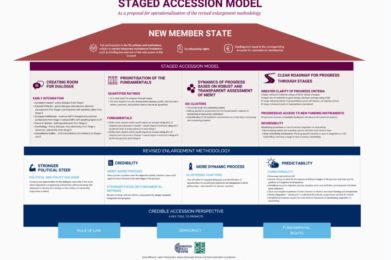
While the European Policy Centre (CEP-Belgrade) published its first proposal on gradual integration back in 2018, it introduced a more structured approach in 2021 in the form of the ‘Template for Staged Accession to the EU’. Developed in cooperation with the Centre for European Policy Studies (CEPS-Brussels), it outlined a four-stage process with the aim of moving beyond the binary approach to enlargement and addressing the then-apparent impasse in accession prospects.
Its unique value lay in the fact it addressed the concerns of both candidate countries and member states while building upon the 2020 revised enlargement methodology. On the one hand, it entailed linking access to increased institutional and financial benefits to the level of reforms achieved during the pre-accession period. By doing so in a gradual, merit-based, and reversible manner, the proposal was intended to increase the predictability and credibility of the entire process, thereby unlocking the political will of candidate countries for essential reforms. On the other hand, it addressed concerns about the difficulties of decision-making in an enlarged but unreformed Union by introducing temporary institutional limitations and enhanced post-accession monitoring for new member states. This was intended to ensure that enlargement can proceed even if the EU’s internal reforms remain unfinished by the time a candidate country fulfils accession requirements.
Through these arrangements, the Model demonstrated that it is possible to pursue simultaneous deepening and widening of the Union without conditioning the latter on the former.
… to the updated Template 2.0
While initially met with caution, the Model’s relevance sharply increased just a year after its inception, when the June 2022 European Council endorsed the idea of “gradual integration” as the official approach to enlargement. Against this backdrop, CEP and CEPS published in 2023 the ‘Template 2.0 for Staged Accession’.
Template 2.0 emerged from wide-ranging consultations with officials from EU institutions and member states, as well as a series of publications that delved into the specific elements of the original proposal. The purpose of the revised approach was to provide a more detailed roadmap for the Model’s operationalisation in practice and make the most of the newly ignited enlargement momentum. In particular, it outlined a step-by-step pathway towards maximising the potential of gradual institutional and financial incentives, while also describing how post-accession veto limitations, including safeguard clauses, could be implemented in line with the EU’s legal order.
Looking ahead, the Model is well-positioned to serve as a blueprint for the EU’s enlargement preparations, particularly in the context of ongoing discussions on safeguard clauses and other temporary post-accession limitations for newcomers.
The Role of Civil Society in Re-shaping EU Enlargement Policy in the Context of Geopolitical Changes: The Model for Staged Accession to the EU as a Case Study
The operationalisation of the Staged Accession Model has been supported by the Open Society Foundations Western Balkans (OSFWB). It included projects such as:
2024/25
“All in on EU Enlargement – Making Gradual Integration Work“
2023/24
“Building a Consensus on the Initiative for Staged Accession to the EU”
2022/23
„Support for further development of the model of the Western Balkans staged accession to the EU“
Stay tuned for updates on the staged accession by subscribing to our special newsletter edition!