Headquarters: Svetog Nauma 7, 11000
Office address: Đorđa Vajferta 13, 11000
Phone:: +381 11 4529 323
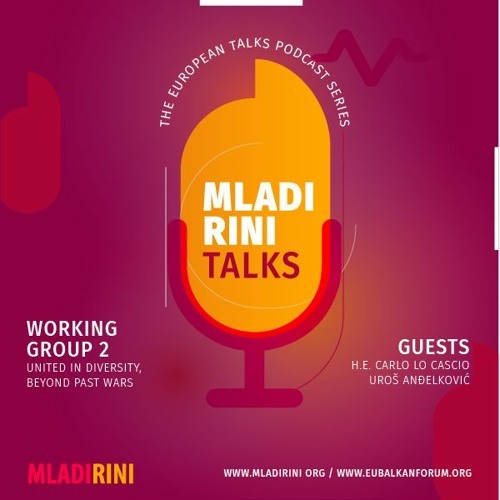
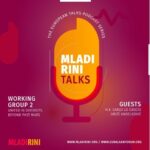
- Host: Lola Paunović
- Guests: H.E. Carlo Lo Cascio Uroš Anđelković
- Published:
United In Diversity, Beyond Past Wars
Or listen:
We are proud to present you a new mini-series of five podcast episodes within our MladiRini Talks, achieved in cooperation with the EU Balkans Forum.
EU Balkans Forum is an opportunity for youth from the entire European continent to discuss common issues, face policymakers and mobilize new energies from below, facilitating the emergence of a young transnational network to engineer new initiatives and bring about fresh views on both the EU and Balkan integration. The Regional Cooperation Council (RCC), Regional Youth Cooperation Office (RYCO), Study Center for International Politics from Rome, and the Osservatorio Balcani Caucaso Transeuropa were involved in the creation and work of the forum. The forum was financially supported by the Italian Ministry of Foreign Affairs and International Cooperation.
Within this initiative, two university students for each of the 27 UE Member States and four from each of the Western Balkans 6 countries gathered together in Rome to discuss topics on the importance of the Western Balkans and the EU. They were divided into five working groups.
Now, you have an opportunity to hear what their experiences were, what they learned, what are the common problems that young people from the EU and the Western Balkans share.
In the second episode, our guests were the Italian Ambassador to Serbia, H.E. Carlo Lo Cascio, and Uroš Anđelković, Serbian UN Youth Delegate at Una Serbia. He was included in Working group 2: United In Diversity, Beyond Past Wars.
The last 25 years have shown the lack of a real engagement of high-level politicians and governments in supporting and promoting the multi-lateral reconciliation process. That’s why, for example, educational systems in many Western Balkan countries have been shaped by mono-national narratives based on the concept of victim vs. antagonist.
Being a very sensitive issue within the region, could such topic be adequately discussed with colleagues from the EU? If youth is involved in the reconciliation process as well as the EU integration process, will they be able to get some sense of ownership of their present and future and hence become less sceptic of the process?
The new episode will arrive every Monday at 14.00.
Subscribe to European Talks and do not miss our next episodes!
More information: www.mladirini.org / www.eubalkanforum.org
Latest episodes

Bridging the Gap: Convergence strategies for Western Balkans’ EU future
This episode of WeBER Talks is dedicated to economic growth challenges and opportunities for the Western Balkans. WeBER 3.0 guest is Nicola Pontara, Country Manager of the World Bank in

Pursuing More Deliberative Democracy and Citizen Participation: Where and How to Begin?
In this 11th episode of WeBER2.0 podcast, a special edition of European Talks focusing on the EU integration of the Western Balkans, host Miloš Đinđić, Programme Manager of the European

From Opinions to Impact: Experience in Implementing Deliberative polling in North Macedonia
In the tenth episode of WeBER Talks, we welcome Ms. Simonida Kacarska, Director of the European Policy Institute (EPI) in Skopje, a member of the Think for Europe Network and