Headquarters: Svetog Nauma 7, 11000
Office address: Đorđa Vajferta 13, 11000
Phone:: +381 11 4529 323


The long-anticipated parliamentary elections in Serbia are around the corner. The key factor to look at on election day is the turnout rate. Voter turnout in Serbian parliamentary elections from 2012 to 2023 averaged 55.52%, with a minimum of 48.88% (2020, due to the opposition boycott) and a maximum of 58.77% (2023). All the experts we have engaged with agree that turnout is not expected to fall below 65%. This implies an increase of almost 10 percentage points over the average, or about 17% in relative terms. At a turnout of 65%, roughly 4.1 million valid votes would be cast, about 400 thousand more than in 2023. Accordingly, this blog outlines several scenarios showing how different turnout levels could translate into seats in the 250-seat National Assembly, with particular attention to the 126 seats needed for a majority. Together, they offer a framework for evaluating the ruling parties’ electoral prospects, and the Student List’s potential to alter the post-election balance of power.
Ever since 2014, the Serbian Progressive Party (SNS) has maintained stable support. To be precise, support has varied between 1.63 million and 1.95 million voters. This is roughly double the 940 thousand voters it had when it first came to power in 2012. The trend suggests that, regardless of ongoing protests and domestic turmoil, SNS can count on at least one and a half million voters. These are the so-called “locked-in” voters. One part of this group is made up of eager supporters of the government. The other part is the “capillary votes”, i.e. votes obtained in exchange for a job, a service or some other benefit, including intimidation. This time around, however, the challenge the regime is facing is the most severe one, and the experts we have engaged with agree that it would be very difficult for SNS to secure more than 1.7 million voters.
With that assumption in mind, to illustrate what higher turnout would mean for SNS, we modelled four scenarios. Scenario 1 shows SNS governing alone at 65% and 70% turnout. Scenarios 2 to 4 add its coalition partner, the Socialist Party of Serbia (SPS), which either repeats its 2023 result of about 250,000 votes (Scenario 2), just clears the 3% threshold (Scenario 3) or falls just below it (Scenario 4). All scenarios assume 6.5 million registered voters and 97.3% valid ballots, and that the lists below the 3% threshold waste about 7.4% of valid votes at 65% turnout and about 7.0% at 70%. Among these, based on our engagement with different experts, Authentic Right and European Serbia are assumed to fall below the threshold, and we add 2.5% for the remaining small lists. In Scenario 4, the votes of SPS are wasted as well, which raises the total to about 10%. The 3% threshold is calculated on all voters who voted, so it equals about 127,000 votes at 65% turnout and about 137,000 at 70%. Seats are estimated from a proportional allocation, not an exact d’Hondt calculation.
Scenario 1: Single-party SNS government at 65% and 70% turnout (~4.11 and ~4.43 million valid votes)
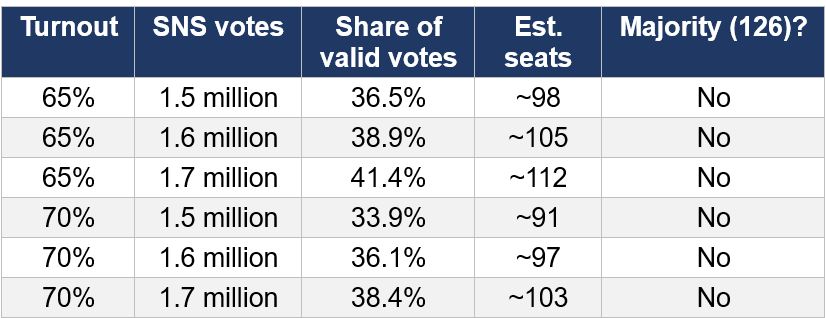
With 65% turnout, SNS would need about 1.92 million votes to govern alone, a level it last exceeded in 2020, an election marked by an opposition boycott and the lowest turnout of the 2012–2023 period. With 1.5 to 1.7 million votes, it would be 14 to 28 seats short. With 70% turnout, SNS would need about 2.07 million votes to govern alone. With 1.5 to 1.7 million votes, it would be 23 to 35 seats short. This puts SNS in an uncomfortable position. In the past, it could usually govern on its own, yet it still brought in partners such as SPS as insurance to secure their loyalty.
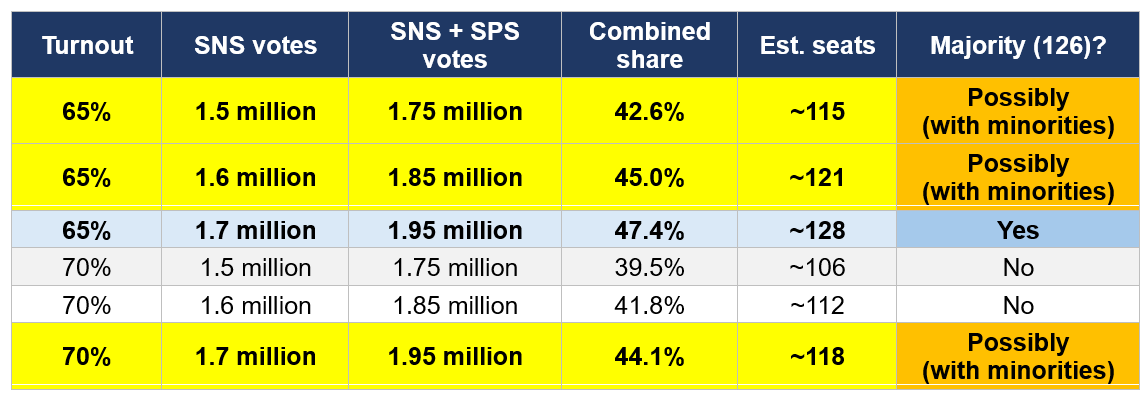
Our estimate is that how well SNS performs matters less than how SPS does and whether it passes the threshold at all. Accounting for this, we present three additional scenarios. In the highly unlikelyscenario that SPS repeats its 2023 result of about 250,000 votes (Scenario 2), it would bring roughly 16 seats at 65% turnout and 15 seats at 70%. In share terms, 250,000 votes is about 6.1% of valid votes at 65% turnout and about 5.6% at 70%, compared with about 6.7% in 2023. The majority is then reached only if that figure is combined with 1.7 million SNS votes at 65% turnout (about 128 seats). However, with a weaker performance by SNS, the role of the minorities would become the most critical factor for the ruling coalition to stay in power.
Scenario 2: Coalition with SPS added (assuming SPS keeps its 2023 result of ~250,000 votes)
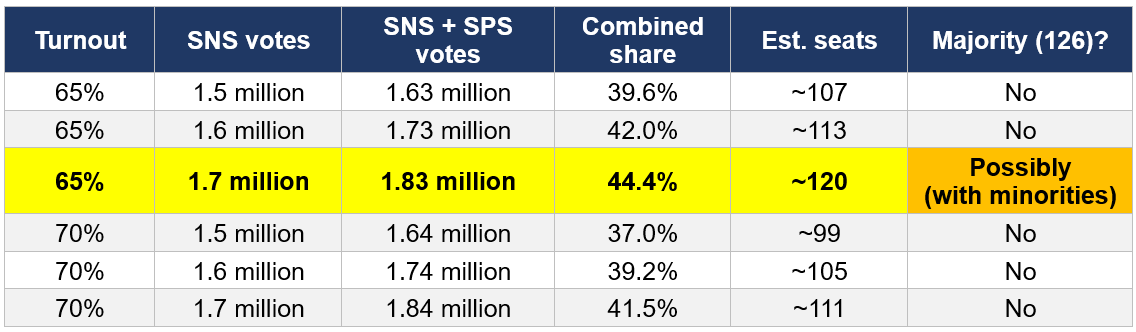
At exactly the 3% threshold, which is within the realm of possibility, SPS would receive about 127,000 votes at 65% turnout and about 137,000 at 70% (about 3.1% of valid votes), which would bring it roughly 8 seats (Scenario 3). That is about half of its 2023 vote count (about 250,000) and about half of the seats it would bring in Scenario 2. The combined list would need about 1.92 million votes at 65% turnout and about 2.07 million at 70%, i.e. about 1.79 and 1.94 million from SNS alone, which is unlikely. Therefore, with 1.5 to 1.7 million SNS votes, the combined list would reach about 107 to 120 seats at 65% turnout and about 99 to 111 at 70%, so no case produces a majority. Taken together, the ruling parties could stay in power only if several conditions hold at once: turnout does not rise above about 65%, SNS holds its upper range of about 1.7 million votes, SPS clears the threshold, and the minorities side with the coalition. If any one of these fails, the regime loses power.
Scenario 3: Coalition with SPS added (assuming SPS gets 3%)
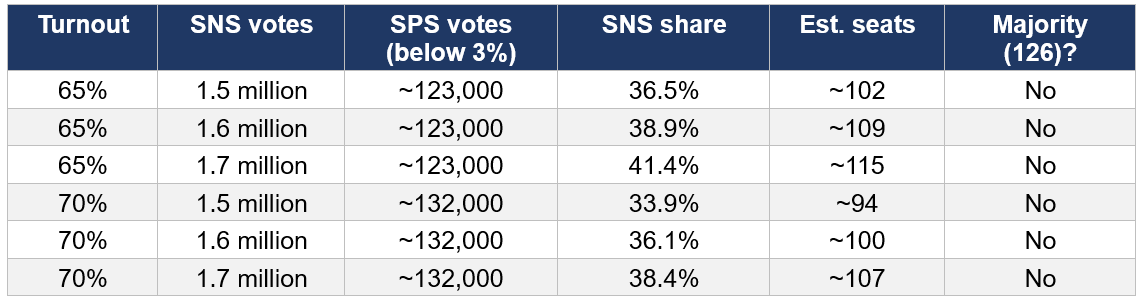
In the quite possible situation in which SPS finishes just under the threshold (about 2.9% of the turnout), it would get about 123,000 votes at 65% turnout and about 132,000 at 70% (Scenario 4). These votes are wasted, so SPS wins no seats and total waste rises to about 10% (accounting for other parties as well). This lowers the number of votes needed for a majority: SNS alone would need about 1.86 million votes at 65% turnout and about 2.01 million at 70%. With 1.5 to 1.7 million votes, SNS would reach about 102 to 115 seats at 65% turnout and about 94 to 107 at 70%, i.e. 11 to 32 seats short, so no case produces a majority. If SPS does not pass, SNS has almost no chance of forming a government, even with the support of all the minority parties.
Scenario 4: SPS does not make it across the threshold
In this part, we estimate how the Student List (SL) would do under the same assumptions. We treat SL as a residual: it gets whatever remains of the valid votes once everyone else has been accounted for. A similar approach has already been soundly applied in another analysis, albeit under different scenarios. Here, we take away the votes for SNS (1.5 to 1.7 million, as above) and for SPS (exactly at the 3% threshold in Scenario 3, and none in Scenario 4, where its votes are wasted). We also take away the wasted votes, counted list by list as above, which come to about 7% in Scenario 3 and about 10% in Scenario 4. Finally, we assume that the minorities win 12 seats in total, as in 2023 (about 175,000 to 200,000 votes), and everything that remains goes to SL.
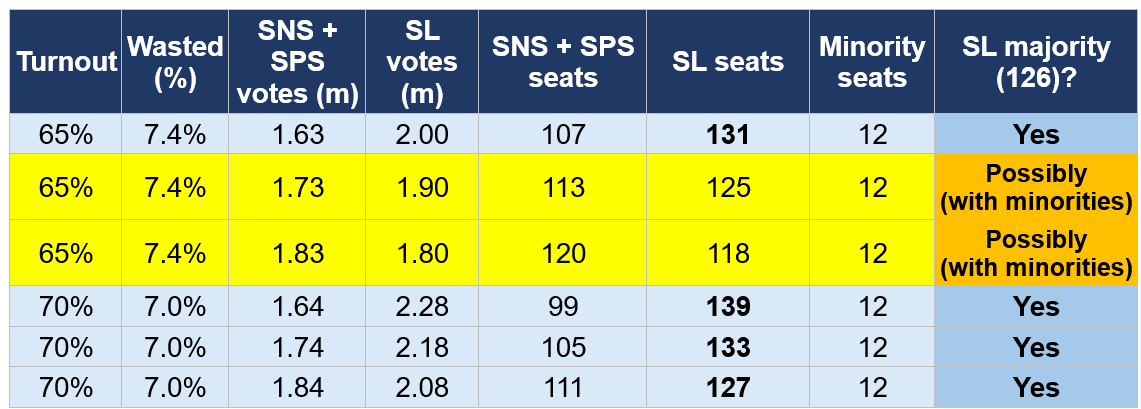
With SPS exactly at the threshold (Scenario 3) and 1.5 to 1.7 million SNS votes, SL would receive between 1.80 and 2.00 million votes at 65% turnout and between 2.08 and 2.28 million at 70%. This would translate into about 118 to 131 seats for SL at 65% turnout and about 127 to 139 at 70%, giving it a majority on its own in four of the six cases, including all three at 70% turnout. In the other two, the minorities would be decisive: with 1.6 million SNS votes, SL would be only one seat short (125 seats), and with 1.7 million, SNS and SPS together would narrowly lead (120 seats to 118), so neither side could govern alone. This is to say that even if SL ends up as the top performer in the elections, this will not automatically translate into an absolute majority, reaffirming the necessity of negotiations with the minorities.
Scenario 3 – SL majority with SPS at exactly 3%
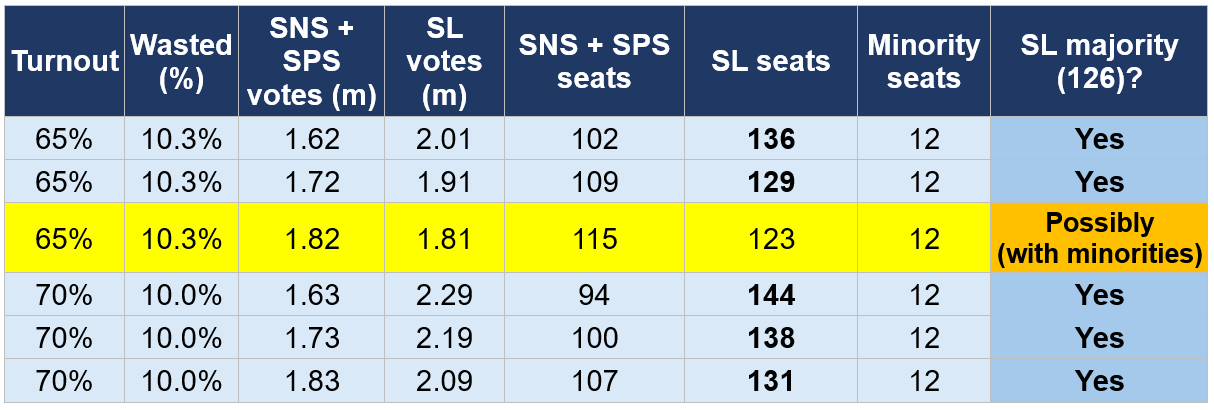
However, if SPS falls below the threshold, SL would be in a commanding position. In this case, the votes of SPS are wasted (Scenario 4), and total waste rises to about 10%. As a result, SL would need only about 1.86 million votes at 65% turnout and about 2.01 million at 70% to form a government on its own. With 1.5 to 1.7 million SNS votes, SL would receive between 1.81 and 2.01 million votes at 65% turnout and between 2.09 and 2.29 million at 70%. This would translate into about 123 to 136 seats for SL at 65% turnout and about 131 to 144 at 70%, making it the single largest list in all six cases and giving it a majority on its own in five of them. The only exception is 1.7 million SNS votes at 65% turnout, where SL would have about 123 seats against 115 for SNS, and would need the minorities’ support to govern.
Scenario 4 – SL majority (alone) with SPS below 3%
The scenarios show that Serbia’s election will be decided less by who finishes first than by who can assemble 126 seats. Although the SL would be the largest list in nearly every case we modelled, at 65% turnout, with 1.7 million SNS votes and the SPS passing the threshold, it would still fall short of the majority needed to form a government on its own. In that situation, minority parties would essentially become the kingmakers. While not accounted for in the scenarios, the possibility that European Serbia and Authentic Right, either both or at least one of them, clear the threshold could further tilt the arithmetic. The count on election night may therefore be only the beginning, with the real contest potentially being fought in the negotiations that follow – assuming, of course, that everything proceeds peacefully.