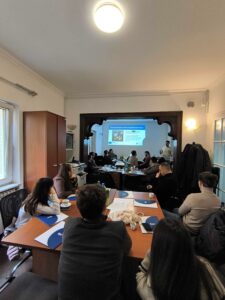
On Monday, December 1st, a technical tripartite meeting was held within the Monitoring Committee for the Reform and Growth Facility, attended by representatives of the Government of the Republic of Serbia, the European Commission, the Delegation of the European Union to Serbia, and the National Convention on the European Union. We remind that the NCEU participates as an equal member of the Committee, the body that oversees the implementation of the Reform Agenda, a planning document that represents the basis for access to EU financial support of up to EUR 1.6 billion under the Growth Plan for the Western Balkans.
Representatives of state authorities of the Republic of Serbia presented an overview of reform steps with a deadline for implementation set for December 2025, along with an assessment of which steps can be completed by the end of the year and which will enter the grace period. The meeting did not address activities for which the Government of Serbia has already submitted funding requests, i.e., those it assessed as completed by June 2025.
Since the Government of Serbia has so far not published any reports on the implementation of the Reform Agenda, civil society representatives did not have access to concrete information on the implementation of the steps previously reported by the Government to the European Commission, while information on activities related to the new steps was presented only orally during the meeting. The NCEU representatives therefore insisted on the following:
- that preparatory materials be distributed to all Committee members before technical meetings are held, in order to enable quality and well-argumented participation and equality of all members, including the member representing civil society;
- that all reports submitted by state authorities to the European Commission as part of the funding requests also be submitted to the National Convention, for the purpose of carrying out its oversight and monitoring function.
Representatives of the NCEU explained that, without access to the complete set of data and reports submitted by the Government to the European Commission as the basis for drawing funds, it is not possible to ensure adequate monitoring of the implementation process of the Reform Agenda.
Representatives of the European Commission supported the reasonableness of these requests, while representatives of the Government stated that they would consider possible ways to fulfil them.
The National Convention recalls that transparency is the fundamental prerequisite for a credible, effective, and accountable process of implementing the Reform Agenda. Without timely access to information on the activities declared as completed, civil society cannot fulfil the role formally assigned to it, as an independent and constructive monitoring partner.
For more than a year, Serbia has been shaken by a political and social crisis whose resolution requires reducing mistrust between the authorities and citizens, while civil society should serve as a bridge. The first step in this regard must be a radical increase in the transparency of reform processes, beginning with civil society. Otherwise, both civil society and EU institutions risk further increasing citizens’ mistrust. It is crucial that the measures declared as fulfilled be based on verifiable data so that the citizens of Serbia can have full insight into the conditions under which EU funds are drawn and the manner in which the undertaken reform commitments are truly implemented.
In this context, NCEU representatives once again expressed concern during the meeting regarding instances where legislative initiatives launched within the implementation of the Reform Agenda were used to introduce additional amendments not described in that planning document, and which, according to NCEU analyses, may potentially undermine the achieved level of human rights, as well as institutional transparency and openness.
The delegation of the National Convention was led by Milena Mihajlović Denić from the European Policy Centre, a member of the Committee and coordinator of the NCEU Multisectoral Working Group for Monitoring the Implementation of the Reform Agenda of the Republic of Serbia. The Convention was also represented by the coordinators of the subgroups for thematic areas under the Reform Agenda: Mihailo Gajić (NALED) for the business environment and private sector development; Damir Dizdarević (BFPE) for green transition; Kristina Obrenović (Partners Serbia) for digital transformation; Nataša Vučković (FCD) for human capital; Zlata Đorđević (Transparency Serbia) for rule of law and fundamental rights; and Lazar Ivanović (CEVES) for monitoring the financial and budgetary implications of the Reform Agenda.