Headquarters: Svetog Nauma 7, 11000
Office address: Đorđa Vajferta 13, 11000
Phone:: +381 11 4529 323


The European Policy Centre (CEP) organized the National “Citizens First” Conference – Toward Citizen-Oriented Public Services in Serbia, within the project Western Balkans Civil Society Empowerment for a Reformed Public Administration (WeBER 3.0). The conference addressed key topics related to improving public administration and service delivery to citizens, including placing citizens at the center of public administration reforms, national and regional experiences in user-oriented public service design, citizens’ views on public service delivery in Serbia, and participatory solutions to local problems in Serbia—drawing on the experiences of WeBER grant recipients.
Across the Western Balkans, public administration reform is essential for building open, transparent, and accountable governments aligned with European Union values. The regional WeBER initiative, predominantly funded by the EU, has been supporting the participation of civil society and citizens in public administration reform since 2015, with a focus on public-facing aspects of administration—transparency, openness, inclusiveness, and accountability. In Serbia, as part of the ongoing WeBER 3.0 project, CEP organized this event to bring together civil society organizations, institutional representatives, the media, and the donor community in a shared dialogue on inclusive, citizen-centered reforms.
Throughout the two previous WeBER cycles, each lasting three years, one key lesson emerged: the need for visible national platforms that highlight the perspectives of citizens and civil society in public administration reform. The “Citizens First” conference directly addresses this gap by giving visibility to reform efforts from the local to the central level and showcasing local innovations developed through the small grants program, one of the core pillars of the WeBER 3.0 project.
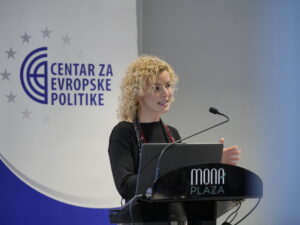
In her opening remarks, Milena Mihajlović Denić, WeBER Project Team Leader and Program Director at the European Policy Centre (CEP), recalled the original idea behind the WeBER initiative—to maintain pressure on authorities to continue administrative reforms by strengthening civil society and empowering citizens, even after EU enlargement, when the leverage of EU conditionality weakens and the SIGMA-OECD mandate ends. She also highlighted examples of effective cooperation between civil society and professional public administration across the region through the WeBER Policy Lab, a collaborative format between public institutions and civil society that applies human-centered, design-thinking methods to solving real-life citizen problems. In Serbia specifically, this process led to the joint development of prototypes for an integrated service for changing surnames and personal documents after marriage or divorce—an issue that currently requires visits to multiple institutions, numerous separate procedures, and significant costs for citizens. This initiative is also gender-sensitive, recognizing that the burden of these administrative procedures disproportionately affects women and that solutions must be designed to address their specific needs.
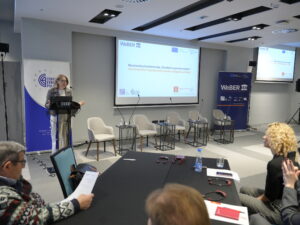
H.E. Pernille Dahler Kardel, Ambassador of the Kingdom of Denmark to the Republic of Serbia, emphasized that the progress achieved with Montenegro is clearly visible in the case of Albania as well, and expressed hope that the same trend will be seen in Serbia. She noted that significant work remains in the areas of the rule of law, media freedom, and freedom of expression, but expressed confidence that Serbia can remain firmly committed to this process. She added that public services still do not fully meet citizens’ expectations, highlighting the fundamental importance of building and maintaining basic trust between citizens and institutions.
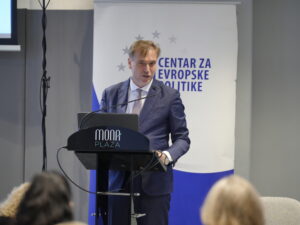
Črtomir Peter Fisinger, Head of the Political Section at the Delegation of the European Union to the Republic of Serbia, pointed out that public administration reform is one of the key pillars of European integration. It encompasses strengthening governance at all levels, including equality and accountability, increasing professionalism, depoliticization, transparency, as well as issues related to recruitment and dismissal in the civil service. If the purpose of public administration is to serve citizens, then citizens must be included in this transformation. He stressed that this is precisely the essence of this EU-funded project—to promote a public administration that is centered on citizens.